
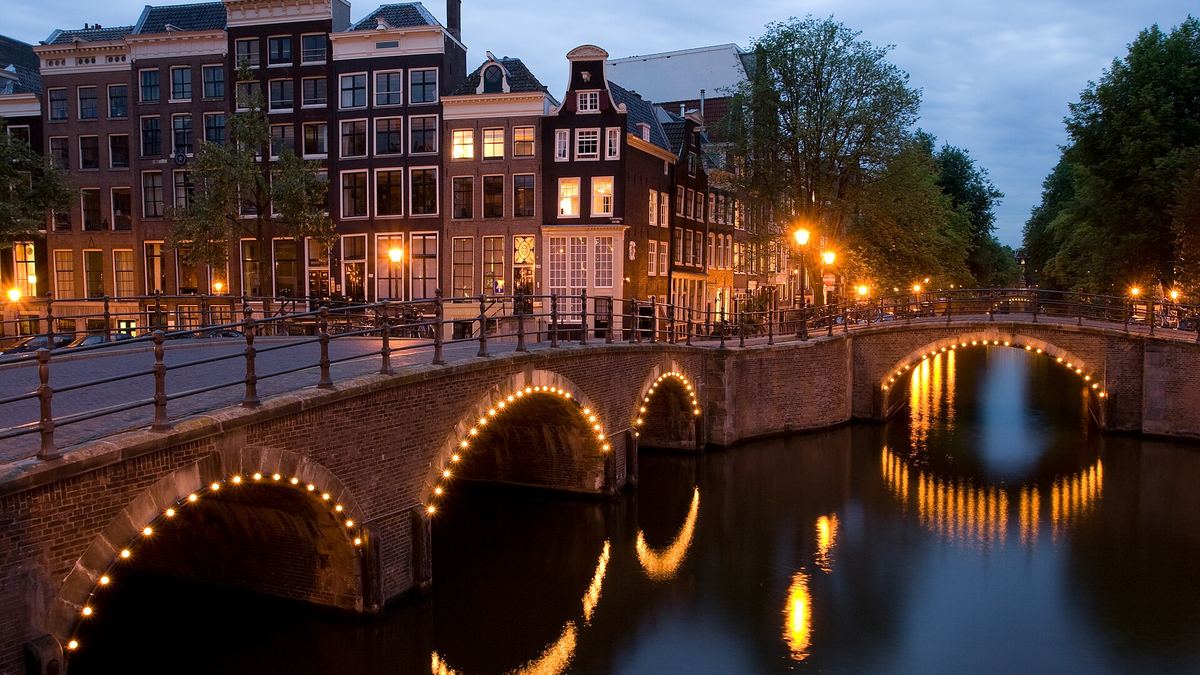
Two worlds a railway bridge apart. The 17th-century Western Islands (Prinseneiland, Realeneiland, Bickerseiland) were built for timber, tar, herring packers and shipyards and now hold quiet canals, drawbridges and a children's farm. Under the railway, the Spaarndammerbuurt is the red-brick workers' district of the 1910s-1920s, where the city, the housing associations and the Amsterdam School each built their ideal homes, ending at Michel de Klerk's Het Schip. The stops follow the routes written by guides from Museum Het Schip and I amsterdam.
Best time: Tuesday to Sunday, late morning, so you reach Museum Het Schip (11:00-17:00) for a guided tour; the 15:00 tour is in English
The route, stop by stop
- 1Het Stenen Hoofd
Westerdoksdijk 1. A harbour pier of 1902, resting on 11,000 piles; until 1968 ships' cargo was moved here to lorries and trains, and the Holland America Line sailed from it. The shed was pulled down in the late 1970s and the head of the pier dug away, leaving the lagoon with old foundations still visible. 10 min.
- 2Zandhoek, Realeneiland
From 1617 cheap land here went to herring fishermen from outside the city; on the Zandhoek, facing the IJ, the Reael family built a herring packing house in 1648. Its gable stone with the Gouden Reaal, a coin bearing Charles V, later gave the whole area its name. 10 min.
- 3Zoutkeetsgracht
Named after the salt-boiling works that lined both sides in the 17th and 18th centuries. Look up for gable stones with fish, and at the far corner for F. Starik's ceramic 'De Zwaaiende Fietser' (the waving cyclist); 15 identical tiles hang on street corners in the Spaarndammer- and Staatsliedenbuurt. 5 min.
- 4Sloterdijkerbrug
The only double wooden drawbridge in the area still in its original state, linking Sloterdijkerstraat with Prinseneiland; a municipal monument since 1995. 5 min.
- 5Prinseneiland and the Palmentuin
Built for timber and tar storage, the island held over 100 of Amsterdam's 900 warehouses and barely any residents until after the Second World War; artists rediscovered it. By Prinseneiland 40 is the Palmentuin, a small public garden full of palms. 15 min.
- 6Kinderboerderij De Dierencapel, Bickerseiland
Bickersgracht 207 (opposite number 207), a volunteer-run children's farm on the water. Bickerseiland once had about ten shipyards; it stopped being an island when the railway embankment was built in 1878. 15 min.
- 7Ferdinand Domela Nieuwenhuis statue, Nassauplein
Walk west to the Nassauplein. Johan Polet's statue of the socialist leader, fist raised, was unveiled on 29 August 1931; Prometheus is shown at the foot. Under the viaduct on the Spaarndammerstraat, Hildo Krop's sculptures 'Overvloed' and 'Verkeer' face each other, with snake heads for capital trodden underfoot. 10 min.
- 8Zaandammerplein (the 'Red Square')
Municipal housing by K.P.C. de Bazel for the city's 3,500-homes plan: plainer than the housing associations' blocks, with only a rinsing corner instead of a kitchen. So many communists lived here that it was called the Rode Plein; on 1 May red flags hung from almost every house. 10 min.
- 9Zaanhof
A closed court of housing by Walenkamp. The small war memorial by G.A. Roobol is the scene of a local 4 May commemoration where Allied flags are raised (traditionally including the Soviet flag). One of the inscriptions over the gates refers to the Housing Act of 1901. 10 min.
- 10Het Schip
Oostzaanstraat 45, on the Spaarndammerplantsoen. Michel de Klerk's 1919 block for the housing association Eigen Haard, nicknamed 'the Ship' for its long triangular shape: originally 102 homes (now 82), a meeting hall, a school and a post office. Look for the little windmills, hanging roof tiles, wrought iron and shaped house numbers. Restored in 2018 with Getty Foundation support. Museum Tue-Sun 11:00-17:00; tours of the slum dwelling, post office and museum flat at 12:00-16:00 on the hour (EUR 2 supplement; 15:00 in English). 75 min.
More walks in Amsterdam
- Old centre: Centraal, the Wallen and Dam to the Begijnhof
- De Pijp food-grazing walk: market, broodje pom and bakeries
- Canal ring and Jordaan: Anne Frank to the Nine Streets
- Jewish Quarter and Plantage to the windmill brewery
- Across the IJ: free ferries to Eye, Noord and NDSM
- Jordaan brown-cafe crawl
- Amsterdam School in Plan Zuid: from the Coöperatiehof to De Dageraad and the first skyscraper
- Oost: Oosterpark, the Dappermarkt and the Javastraat to Flevopark
- Noord by bike: the Waterland dyke from Nieuwendam to Schellingwoude and Durgerdam