
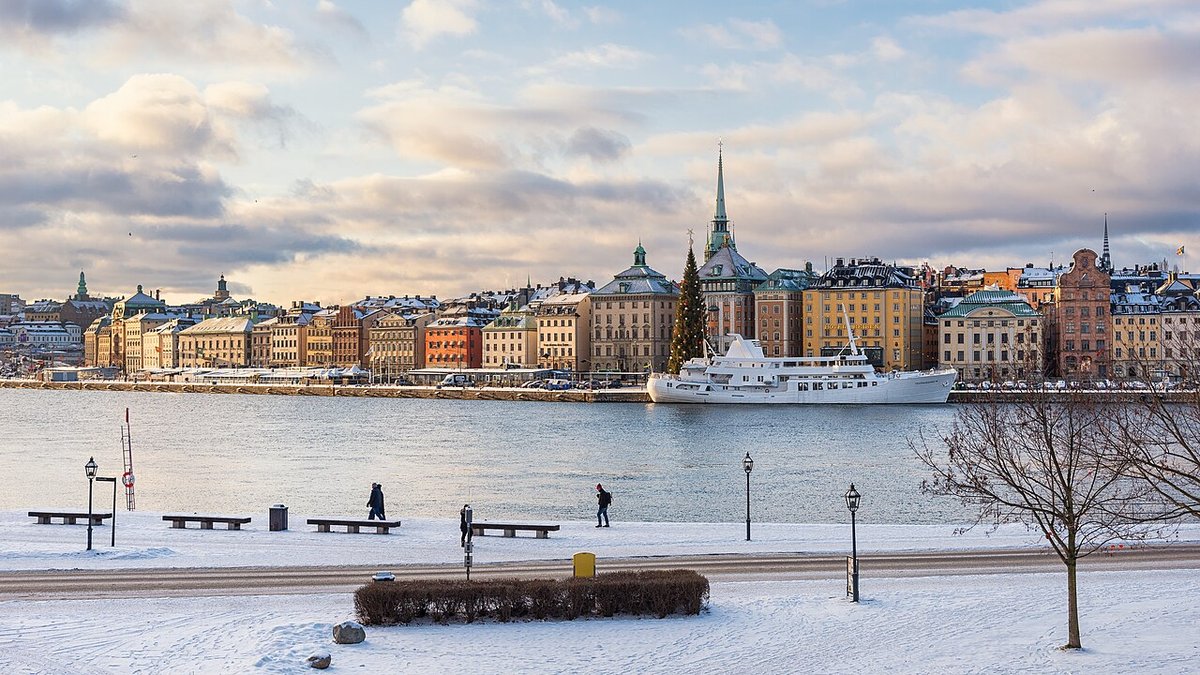
Walk the high ground of east Södermalm, where painted wooden houses went up after the Katarina fire of 1723 and the city's poor settled around Vita bergen in the 1700s. Katarina kyrka, the painted wooden houses of Mäster Mikaels gata, the harbour view from Fjällgatan, Vita bergen with Sofia kyrka and the cultural reserve of Åsöberget, ending at the Fåfängan lookout above the harbour entrance.
Best time: Late afternoon, then sunset at Fåfängan; dry weather, as the lanes are steep and cobbled
The route, stop by stop
- 1Katarina Church
Built 1656-1695 to Jean de la Vallée's design; it has burned twice, most recently in 1990, and was rededicated in 1995; named after Karl X Gustav's mother Katarina. Walk round the churchyard. 15 min.
- 2Mäster Mikaels gata
Wooden houses finished in 1729, built after the Katarina fire of 1723 despite a ban on timber houses, with smooth vertical panelling painted in linseed-oil colours. The street is named after the city executioner Mikael Reissuer (1635-1650). 10 min.
- 3Fjällgatan
At 27.8 m above the water, the street known for its view over the harbour entrance and central Stockholm, with houses on both sides that Stadsmuseet rates as of very high historic value. The writer Per Anders Fogelström lived in the attic of no. 30 from 1964 to 1998; Per Anders Fogelströms Terrass below nos. 34-36 is named after him. Take the Sista Styverns trappor stairs (between no. 26 and 30) up to Stigbergsgatan. 15 min.
- 4Stigbergsgatan
A protected row of historic wooden houses owned by the city's heritage company AB Stadsholmen; the hill once held one of the city's gallows. 10 min.
- 5Sofia Church
The church on the highest point of Vita bergen (46 m), consecrated in 1906. Around it lies the hilly park Vita bergen ("Vitan"), large parts of it a cultural reserve since 1956, with a music pavilion on the south-east summit. 20 min.
- 6Lotsgatan
A short cul-de-sac of low falu-red wooden houses (nos. 1-9), once home to workers from the Södra varvet shipyard below. Part of the Åsöberget reserve. 5 min.
- 7Åsöberget wooden houses
With Djurgårdsstaden, the largest group of wooden houses in Stockholm, a cultural reserve since 1956 owned by AB Stadsholmen. The small park at the top (37 m, laid out 1929-1934) looks over Saltsjön and the harbour entrance. 15 min.
- 8Fåfängan
The lookout on the far eastern tip of Södermalm, ringed by clipped lime trees, named after the 1770s summer house ("folly") of the merchant Fredrik Lundin. The four flags are raised when the café-restaurant is open. 30 min.
More walks in Stockholm
- Gamla stan beyond the crowds: Riddarholmen, Stortorget and the back lanes
- Söder heights at sunset: Mariaberget, Monteliusvägen and Skinnarviksberget
- Djurgården: Vasa, Rosendal and the art villas to Blockhusudden
- Skeppsholmen and Kastellholmen: the museum island and the citadel
- Östermalm and Strandvägen: Hallwylska, the market hall and the waterfront boulevard
- Kungsholmen waterfront: City Hall, Norr Mälarstrand and Rålis to Västerbron
- Långholmen and Reimersholme: the prison island and the bathing rocks
- Hagaparken: Gustav III's pavilions and the Copper Tents on Brunnsviken
- Vasastan: Strindberg's Blue Tower, the observatory hill and Asplund's library
- Skogskyrkogården: Asplund and Lewerentz's Woodland Cemetery (UNESCO)
- Tunnelbana art ride: T-Centralen, Kungsträdgården, Rådhuset, Solna centrum, Stadion, Tekniska högskolan